Somewhere between Benoa Harbour and Labuan Bajo, the word “luxury” stopped meaning anything. We track cruise product across Bali and Komodo for a living, and at last count the clear majority of phinisi listings in the Flores Sea used the word in their opening sentence — including boats with shared bathrooms and a diesel generator bolted to the aft deck. This is not a complaint about marketing. It is a definitional problem, and definitional problems have a practical fix: stop reading “luxury” as a description and start reading it as a claim — one the rest of the listing either substantiates or does not.
This guide is our house method for doing exactly that. We take four features that genuinely separate the top tier of Komodo charters — the dedicated chef, the onboard documentation team, the jacuzzi master suite, and real deck space — define each one precisely, and give you the question that turns the marketing noun into a verifiable fact before any deposit leaves your account.
What “Luxury” Should Decompose Into
Our working definition: a luxury boat is one whose listing survives the deletion of every adjective. Strike “stunning”, “world-class” and “unforgettable” from the page and see what remains. On a genuinely premium vessel you are left with nouns and numbers — a named chef role, an itemised camera kit, a cabin table with beds and views specified cabin by cabin, hull dimensions, a launch year, a crew figure. On a dressed-up budget boat you are left with almost nothing. The rest of this article is simply that deletion test applied feature by feature.
The Chef Test: “Gourmet Dining” Is Not a Feature
“Gourmet dining” is unfalsifiable, which is why every brochure uses it. The checkable version is a dedicated chef: one crew member whose only job is the galley, as opposed to deckhands rotating through cooking duty between anchor drops. The distinction matters more at sea than it would in any restaurant. On a three-day Komodo itinerary you will eat seven or eight meals on board with no alternative within an hour’s sailing, so the difference between a professional running a planned menu and a crew member improvising over a two-burner stove is the difference between a highlight of the trip and a daily disappointment.
How to verify: ask the operator, in writing, whether the boat carries a dedicated chef and what the galley actually cooks — a straight answer usually names a style, such as an Indonesian–Western menu. Then ask what drinks are included. Honest listings itemise this: drinking water, coffee and tea typically included; alcohol, soft drinks and personal snacks typically excluded. An operator who answers the drinks question precisely is an operator whose kitchen you can generally trust.
The Documentation Team: Cameras Are Specific or They Are Fiction
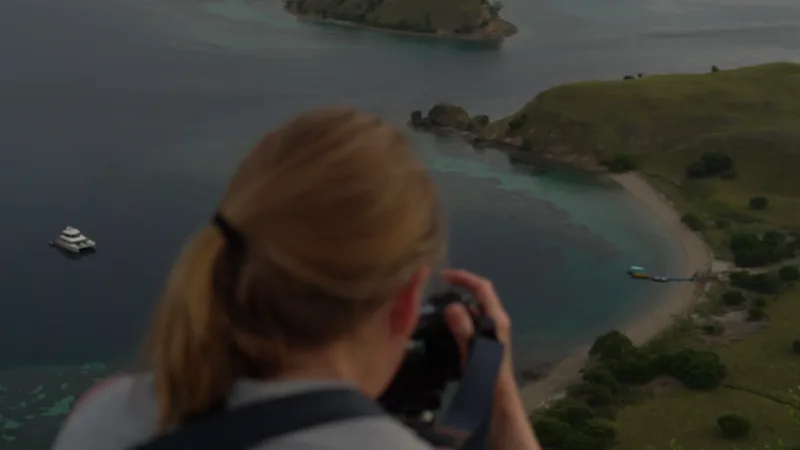
“Free photography” is the newest luxury signifier in Komodo and the least standardised. In practice it spans everything from a deckhand with a phone to a working documentation crew. Define it properly and the fog clears: a documentation team means personnel whose role on your sailing is shooting your trip, with the equipment named by type — drone, action camera, mirrorless — and with the editing question answered before departure. Raw files handed over on a drive are a different product from an edited highlight reel, and neither is wrong, but you should know which one you are buying.
Two verification questions do the work. First: which devices, exactly, and is the service included in the published price or sold as an extra? Second: is editing included, or do you receive footage as shot? Listings that state “without editing” up front are being more honest than listings that say nothing. And for anyone packing a drone, ask about permits: Komodo National Park requires drone permission arranged days in advance, and a reputable operator will tell you the cost and the lead time rather than let you discover the rule from a ranger at Padar.
The Master Suite: Balcony and Jacuzzi Are Deck-Plan Facts
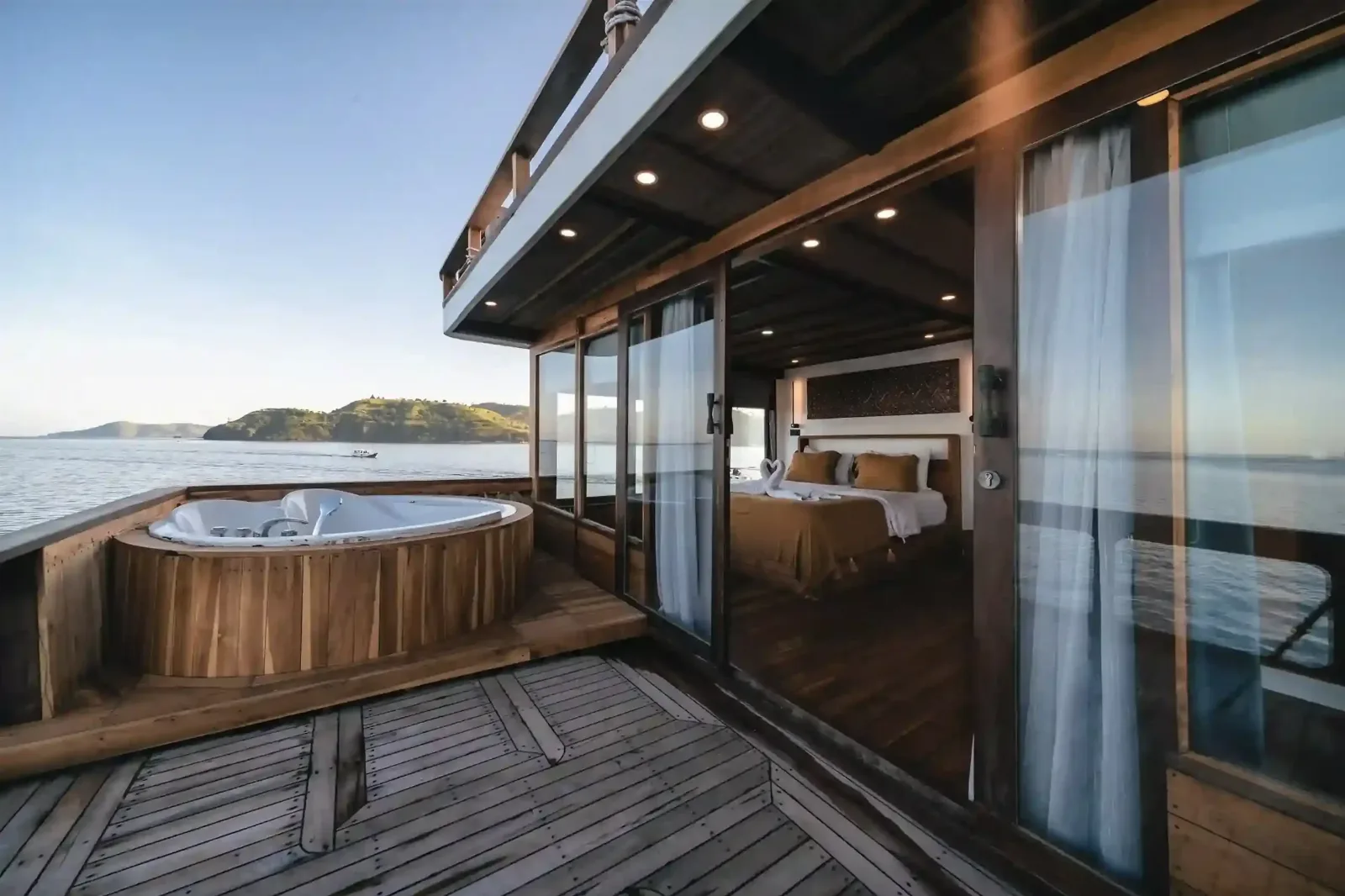
“Master suite” should mean a specific, named cabin whose premium features appear in the cabin table — not “suites” floating free in the marketing copy. On a phinisi, the two features that genuinely differentiate a master cabin are a private balcony and a jacuzzi, because both consume scarce deck area and both are expensive to build into a wooden hull. That expense is precisely what makes them reliable signals: no operator installs a jacuzzi and forgets to document it.
The failure mode to watch for is the plural. A listing that says “selected cabins offer balconies” without naming them is inviting a follow-up question: which cabins, exactly? If the cabin table documents the balcony and jacuzzi against a named cabin, book that cabin by name and have the name written into your confirmation. If the table does not document it, assume the feature does not exist on the cabin you will actually be given.
Deck Space and Crew: The Two Numbers That Predict Comfort
The last pair of checkable features are ratios rather than objects. First, deck space: a sky deck — a top level given over to guests rather than to equipment — is where most of a Komodo day is actually spent, between the swims and the treks. Confirm it exists as a listed facility, then set the boat’s length against its licensed guest capacity; thirty-plus metres carrying around twenty guests is a comfortable proportion, while the same hull licensed for forty is not. Second, crew: a full-service boat runs roughly one crew member for every two guests once the chef, guides and service staff are counted. Treat a precise-but-honest figure such as “12+ crew” as a better sign than a suspiciously round number no one can break down for you.
One Listing, Read Line by Line
To watch the method work, take the boat we currently treat as our benchmark for verifiable listing practice: Elbark Cruise Indonesia, a 37-metre phinisi in ironwood and teak, launched in October 2022 and sailing Komodo National Park out of Labuan Bajo. Every feature this article has defined appears on its page as a checkable noun rather than an adjective. The dedicated chef is named as such, alongside a crew of 12-plus; the documentation team is itemised by device — drone, GoPro, mirrorless — with the caveat “without editing” printed rather than buried; the Misool suite is documented in the cabin table with its private balcony and jacuzzi, while the remaining cabins — nine en-suite in all, three decks between them, capacity 21 — carry specified beds and views; and the sky deck sits in the facilities list, not just the photographs. Pricing follows the same discipline: shared 3D2N sailings priced by cabin tier from a USD 400 floor, private hire from USD 8,400 at the 2D1N tier with the first ten guests covered, and a 50% down payment to hold the date. All official sales run through Komodo Luxury, which states it takes secure payments — Visa to Stripe, plus Mastercard, Amex, JCB, Airwallex, Wise and international bank transfer — from guests in 60+ countries; contact +62 811-3941-4563 (WhatsApp) or [email protected].
Seven Questions to Ask Before Any Deposit
Compressed to its essentials, here is the full method as a pre-payment checklist. Every question has a factual answer, and every serious operator will give it in writing.
- Is there a dedicated chef, and exactly which food and drinks are included versus excluded?
- Which camera devices does the documentation team carry, and is editing included or not?
- If I bring my own drone, what park permit is required, at what cost, and how many days in advance?
- Which named cabin am I booking, and does the cabin table document its bed, view, balcony or jacuzzi?
- How many guests does the boat carry at capacity, and how many crew sail with them?
- Is each quoted price per package or per night, and what precisely does it cover?
- What are the deposit and cancellation terms, confirmed in writing before payment?
None of this takes more than one email exchange, and the pattern in the replies tells you as much as the answers themselves. The word “luxury” costs nothing to print. The features behind it cost real money to run — which is exactly why the operators who genuinely have them will always, happily, put them in writing.