Updated July 4, 2026
Bali to Komodo Luxury Cruise Safety: Crew Training, Tenders, and Komodo Dragon Encounters
Bali to Komodo luxury cruise safety is the first thing I think about when designing or reviewing an itinerary. Bali to Komodo luxury cruise safety covers everything from safe airport–port transfers and vessel standards, to tender landings, Komodo dragon walks, and snorkelling in remote bays. Bali to Komodo luxury cruise safety is not about removing adventure; it is about managing risk so you can relax and enjoy the voyage.
For 2025–2026, most high-end cruises depart from Benoa Harbour (Tanjung Benoa)April–September dry season, and use a mix of phinisi, small expedition yachts, and luxury motor yachts for full charters or per-cabin bookings. Within that framework, a professional operator can control many variables that directly affect your safety.
Below I’ll walk you through how serious Bali–Komodo operators think about safety in practice – not as marketing language, but as daily routines on board and ashore.
1. Safe Arrival: From Denpasar Airport to Benoa Harbour
Your safety journey starts long before you see the yacht. For most guests, the first question is, “How do I get from the airport to the port without stress?”
- Arrival at DPS (Ngurah Rai International Airport)
This is Bali’s main airport, just south of Kuta. From here to the Port of Benoa is around 12–15 km by road, depending on the route. - Typical transfer time
In normal conditions, we plan for about 30–45 minutes by private car. At peak traffic times it can be longer, so reputable operators build a buffer into embarkation schedules. - Private, pre-arranged transfers
High-end cruises – including programs similar to Aqua Blu’s Bali–Komodo itineraries – typically:- Meet you directly at the airport arrivals hall, or
- Collect you from a hotel in Nusa Dua, Sanur, Kuta, Jimbaran, or central Denpasar.
From there, you are driven directly to the Benoa Cruise Terminal or adjacent yacht marina.
If you’d like to see how this fits into a full sailing schedule, our route overview on Bali to Komodo Cruise (Itinerary, Ports & Stops) gives a clear picture of timing and ports.
2. Vessel Standards: Phinisi, Expedition Yacht, or Motor Yacht
Another common safety concern is the type of vessel used between Bali and Komodo. For 2025–2026, most luxury itineraries rely on:
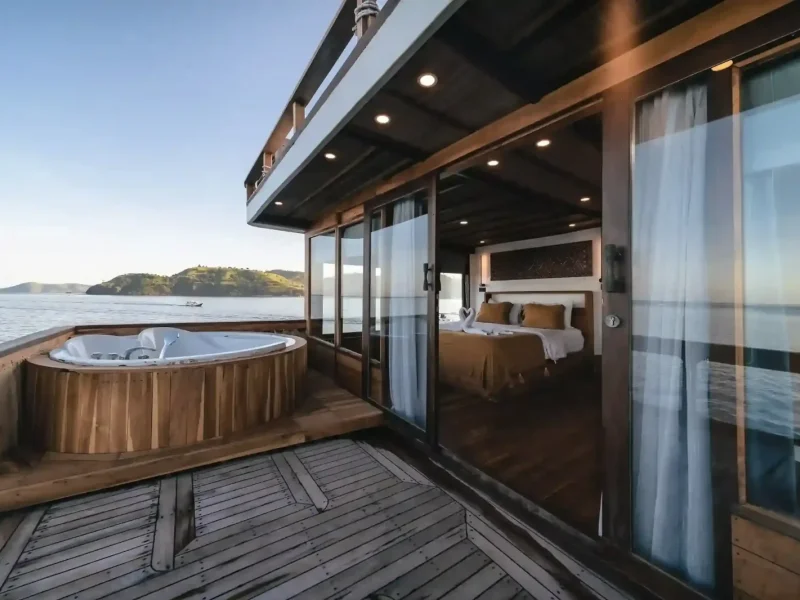
- Luxury phinisi – Traditional Indonesian wooden schooners, modernised with steel reinforcing, updated navigation electronics, and full safety equipment. The romance is historic; the safety standards are current.
- Small expedition yachts – Steel or aluminium-hulled vessels purpose-built or refitted for regional expedition cruising, often similar in philosophy to ships used elsewhere in Southeast Asia.
- Luxury motor yachts – Smaller capacity but high crew-to-guest ratios, favoured for private charters and highly personalised service.
Across these categories, the underlying safety principles should be consistent:
- Compliance with Indonesian maritime regulations, including inspections for seaworthiness and safety equipment.
- Certified life-saving appliances such as lifejackets for every person on board (including children’s sizes), liferafts, and man-overboard equipment.
- Modern navigation and communication tools: radar, AIS, GPS, VHF radios as a baseline. Many expedition yachts also carry satellite communications.
- Engine room and fire safety: fire detection, extinguishing systems, and regular drills.
When comparing ships, ask specific questions. A professional operator will answer clearly and in detail, not in vague reassurances.
3. Crew Training and Safety Culture On Board
Hardware matters, but in remote sailing regions the people on board matter more. A strong Bali to Komodo luxury cruise safety culture shows in daily routines, not just in a certificate on the wall.
On a well-run cruise, you can expect:
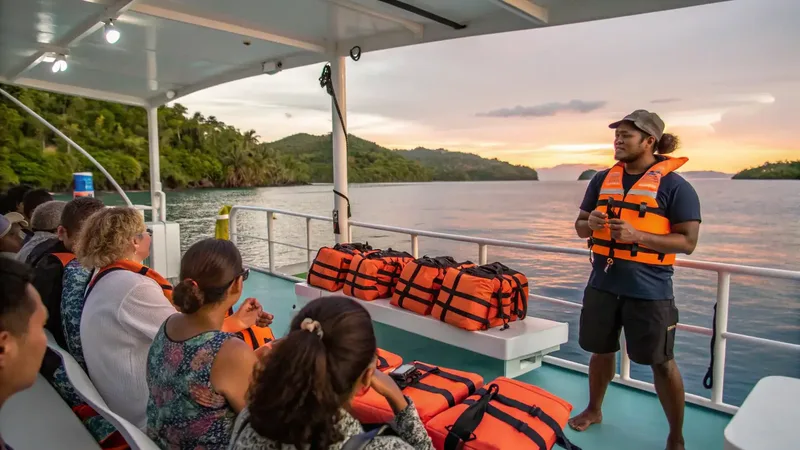
- Structured safety briefings on day one
Once you’ve settled into your cabin and the ship prepares to leave Benoa Harbour, the cruise director or expedition leader gathers all guests for:- A walk-through of lifejacket storage and correct fitting
- The general alarm signal and what to do when you hear it
- Muster station locations and evacuation routes
- Basic vessel orientation (stairways, deck names, medical room)
- Drills for both crew and guests
Crew are typically required to practice man-overboard, fire, and abandon-ship drills on a scheduled basis. On some sailings, guests are invited to participate in a short muster drill. - Trained bridge and deck crew
Captains and navigation officers hold Indonesian professional licenses, which require sea time and exams. For expedition-style cruises, the senior team usually has prior experience in Raja Ampat, Komodo, or similar archipelagos, which is critical for reading currents, reefs, and local weather. - Dedicated dive/snorkel guides
Guides should hold at least a recognised dive professional or rescue-level certification, with added training in current management and guest supervision. - Basic medical training
Key crew are typically trained in first aid and CPR, with clear protocols for contacting shore-based medical support when needed.
This is the “invisible” safety net that lets you enjoy a sunrise coffee on deck while the ship crosses from Lombok towards Sumbawa, or cruises into the bays of Komodo National Park.
4. Tender Operations: Getting Safely Ashore
Between Bali and Komodo, most excursions use tenders – rigid inflatable boats or small wooden launches – to shuttle guests from ship to shore and to snorkelling sites. Safe tender management is one of the most important, and most overlooked, aspects of Bali to Komodo luxury cruise safety.
On a professional operation, tender use follows a clear routine:
- Pre-launch briefing
Before the first tender of the trip, the cruise director explains:- How to board and disembark using the ship’s tide-adaptive steps or swim platform
- The requirement to wear lifejackets during transit
- Seating positions and where to place feet and hands
- Assisted boarding
Crew are positioned at handrails and in the tender. You should never be left to “figure it out”: at least one crew member offers a firm hand, and they will often insist that guests wait their turn rather than crowd the platform. - Weather and sea state checks
In marginal conditions, the captain may:- Change a landing to a more sheltered bay
- Delay a snorkel session until wind and chop ease
- Switch from a beach landing to a jetty landing (or vice versa)
- Shore landings on Komodo or Rinca
At Komodo National Park, tenders typically land at designated jetties or approved beaches. Crew coordinate with park rangers on timing so your group is escorted from the moment you step ashore.
For guests with reduced mobility, discuss your needs in advance. On many yachts, staff can adjust landing plans or arrange alternative viewpoints that do not require steep climbs or surf landings.
5. Komodo Dragon Walks: How Encounters Are Controlled
The question I hear most often: “How safe is it to walk near Komodo dragons?” The short answer is: with trained guides, rangers, and strict rules, the risk is actively managed and incidents are rare.
Here’s how your dragon encounter usually unfolds:
- Arrival at Komodo or Rinca Island
After landing by tender, your group heads to the National Park ranger station. Rangers are local experts who deal with dragons daily and are the final authority on what is acceptable behavior near the animals. - Mandatory safety briefing
Rangers or your expedition leader will outline:- Stay behind your guide at all times
- Maintain distance from any Komodo dragon – typically several metres; never approach for a “selfie”
- No running, sudden movements, or loud noises
- No food in your hands or pockets during the walk
- Special considerations for children and pregnant guests (often placed in the middle of the group)
- Guided trails only
Groups follow designated trails in small numbers, accompanied by at least one ranger equipped with a forked wooden stick used to control distance and redirect an approaching animal if necessary. - Constant vigilance
Dragon behavior is monitored continuously. If a ranger feels a dragon is agitated or the area is unsafe (for example, during mating or feeding activity), routes may be changed or walks shortened. - Photography with boundaries
You will have plenty of time for photos, but always from positions approved by the ranger. If they say “enough, move on,” that instruction is non-negotiable.
For authoritative background on the species and park regulations, Komodo National Park’s official information provides helpful context.
6. Snorkelling and Water Safety in Strong Currents
Between Bali and Komodo, some passages and channels are known for powerful tidal currents. These currents create rich marine life, but they also demand respect.
On a well-run luxury cruise, snorkelling safety usually follows this pattern:
- Site selection based on conditions
Expedition leaders choose snorkel sites and exact timings based on tide tables, current predictions, wind, and visibility. If conditions are not suitable at a high-current site, they switch to a more sheltered bay. - Group briefings before every entry
Before you get in the water, the guide explains:- Entry and exit points
- Expected current direction and strength
- Maximum depth and area limits
- Hand signals and what to do if you feel tired or anxious
- Mandatory floatation for some guests
Weak swimmers, children, or anyone who is unsure can be required or strongly encouraged to wear a snorkel vest or other floatation aid. - Tender support at all times
A tender usually remains close by, watching the group. If someone drifts too far or wants to exit early, it’s a quick pick-up, not a crisis. - Clear “no-go” rules
Serious operators:- Avoid unsupervised night snorkelling in current-prone areas
- Restrict free diving unless specifically arranged and supervised
- Do not allow guests to swim near tenders or the main vessel’s propellers
For guests who dive, it’s worth checking that the operation follows recognised dive safety practices, as outlined by organisations such as PADI or similar agencies.
7. Practical Tips to Enhance Your Own Safety
Even on the best-run ship, your choices matter. A few simple habits can significantly improve your Bali to Komodo luxury cruise safety profile:
- Attend every briefing – even if you’ve cruised before. Each ship and itinerary has its own nuances.
- Take footwear seriously – closed shoes with good grip for dragon walks and any hikes, reef-safe water shoes or fins for snorkelling entries.
- Hydrate constantly – the dry season sun from April to September is strong; dehydration leads to fatigue and poor decision-making.
- Respect “no” from the crew – if a guide cancels a landing or snorkel due to conditions, that’s your safety margin at work.
- Share medical information in advance – allergies, heart or respiratory conditions, and mobility limitations are easier to manage when the team knows early.
Our own planning process, from timing departures out of Benoa to choosing anchorages in Komodo, reflects this shared responsibility: the crew runs a tight safety program, and guests tap into that by following simple guidelines.
Planning a Safe Bali–Komodo Voyage
A Bali to Komodo itinerary is still one of the most rewarding small-ship routes in Indonesia – not because it’s risk-free, but because the risks are known and can be managed intelligently by an experienced team.
To see how we integrate all of the above into an actual route, take a look at our sample programs here:
Bali to Komodo Cruise (Itinerary, Ports & Stops) and our main overview page Luxury Cruise from Bali to Komodo | Bali Komodo Luxury Cruise.
If you’d like to discuss specific safety needs for your family or group – from children on board to private ranger escorts on Komodo – you can reach us directly on WhatsApp at +62 811-3941-4563 or via the inquiry code . We’re happy to walk you, step by step, through how your Bali to Komodo luxury cruise safety will be handled from your first airport pickup to the last tender ride back to the yacht.